Stone Academy · International
How natural stone blocks become slabs
Follow the complete transformation—from block selection and sawing to resin treatment, finishing, quality control and export preparation.Every finished slab begins as a massive geological block, but cutting alone does not create a market-ready product. The transformation requires careful planning, specialized machinery, controlled treatment, experienced inspection and complete traceability. Each decision affects appearance, structural performance, yield and the value that ultimately reaches the fabricator or architectural project.
01 / Selecting and documenting the block
The process begins by evaluating the block’s dimensions, geology, color movement, fractures, natural fissures and recoverable volume. The intended application also matters: a block selected for large architectural panels may require different characteristics from one intended for countertops. Identification numbers, measurements, photographs and source records establish traceability before production begins.
02 / Squaring and preparing the block
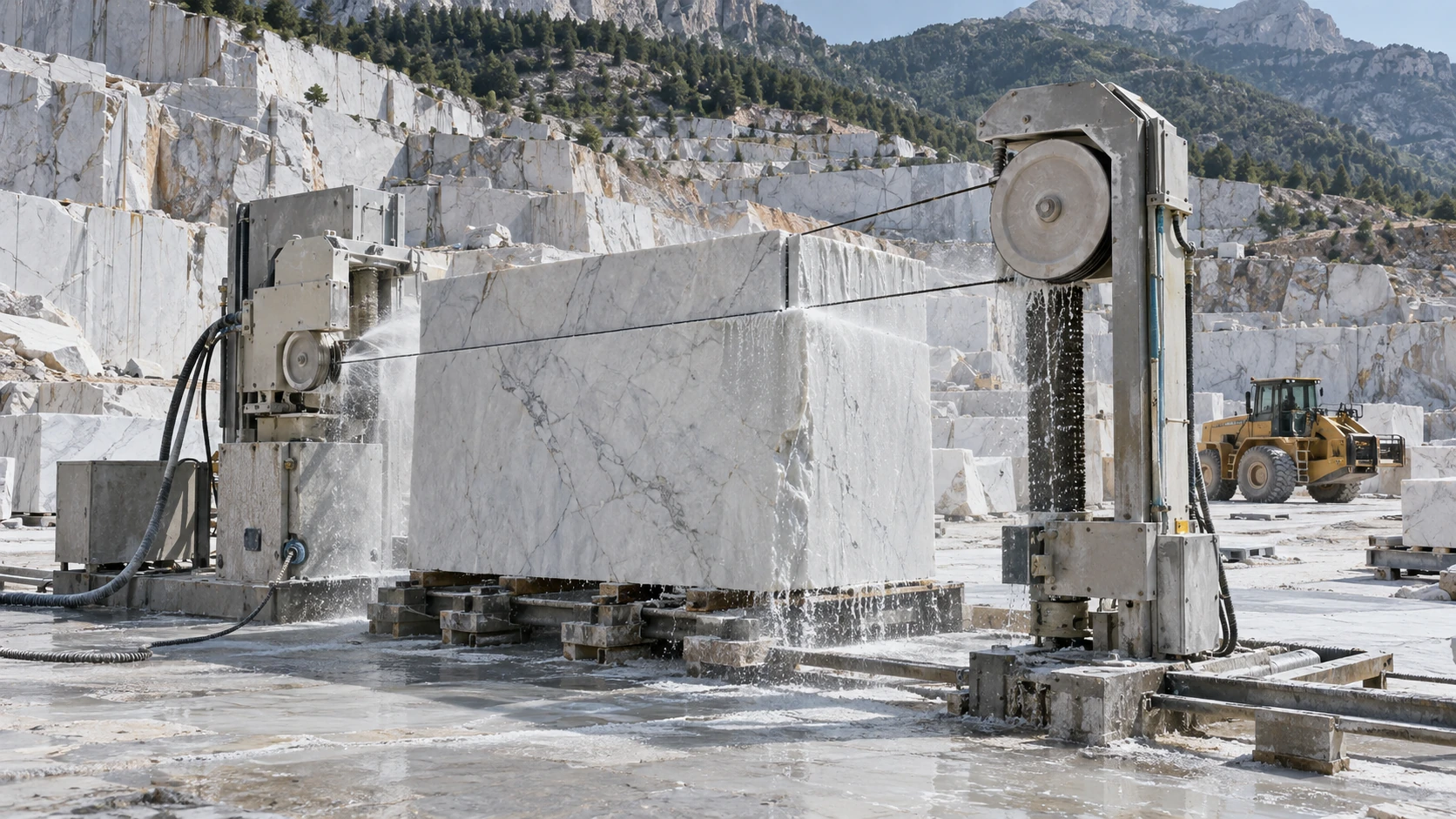
Quarried blocks often have irregular faces. Diamond-wire equipment is used to square the block, remove unstable projections and create surfaces that can sit securely on the cutting carriage. The block is cleaned and stabilized because correct positioning protects the equipment, improves cutting accuracy and reduces preventable material loss.
03 / Orientation and the cutting plan
Before the first cut, specialists determine how the block should be oriented. Vein direction, visual movement, potential bookmatching, target slab thickness, expected yield and known structural characteristics all influence the plan. A poor orientation can hide the strongest visual pattern or reduce the number of usable slabs; a thoughtful plan reveals the material at its best.
04 / Primary sawing
The prepared block enters a gang saw, multi-wire saw or another block-cutting system. Diamond blades or wires move through the stone while a continuous water supply cools the tooling, controls dust and carries away slurry. Cutting is deliberately controlled rather than rushed. The result is a sequential set of rough slabs that preserves the natural order of the block.
05 / Washing, drying and first inspection
Freshly cut slabs are washed and allowed to dry so their true color and structure become visible. Inspectors look for open veins, microfissures, pits, shade changes, mineral deposits and any condition exposed by cutting. This assessment determines which slabs can proceed directly and which require reinforcement or a specific treatment plan.
06 / Reinforcement and resin treatment
When appropriate, fiberglass mesh can be applied to the back and specialized resin can be introduced into surface pores or natural fissures, sometimes with vacuum-assisted equipment. The slab is then cured under controlled conditions. Proper treatment reinforces the material and improves finish consistency, but it does not replace correct block selection or experienced quality judgment.
07 / Calibration and surface finishing
The slab is calibrated to achieve consistent thickness and a level surface. A progressive sequence of abrasives then creates the specified finish—polished, honed, leathered, brushed or another approved texture. Water flow, abrasive selection, machine pressure and line speed must remain controlled to produce an even finish without waves, burn marks or inconsistent gloss.
08 / Final quality control and slab sequencing
Every slab should be evaluated for dimensions, thickness tolerance, flatness, finish consistency, color, visible fissures, completed repairs and edge condition. Slabs are kept in sequence, assigned individual numbers and photographed so designers and fabricators can review movement, coordinate layouts and plan bookmatched or vein-matched installations with greater confidence.
09 / Protection, packing and logistics
Approved slabs are separated with protective material and secured in reinforced bundles, racks or containers designed for their weight and destination. Labels, packing lists, photographs, weights and shipping documents preserve traceability. Correct loading and route planning are essential: a slab that passed production still needs controlled handling to arrive safely and in the documented condition.
This educational article explains the standard industrial process. Exact machinery, treatment, inspection criteria and production sequence vary by material, supplier and project specification.
QUALITY CONTROL · INSPECTION · ONE POINT OF CONTACT
OSO is the bridge between the source and your objective.
Time is one of the most valuable assets in any stone project. Locating a material is only the beginning. A buyer still has to identify the correct quarry or processor, confirm that the supplier is legitimate, understand the stone’s technical and visual characteristics, define acceptable quality, follow production, review the actual slabs, coordinate packing, arrange international transportation and know exactly who must respond if something changes. Trying to learn every one of those steps during an active purchase can consume months, expose the project to avoidable risk and distract the client from the business that already needs their attention.OSO Solutions International is the answer for clients who need quality control, inspection and one dependable point of contact throughout that process. OSO does not simply provide a name or send a supplier’s photographs. The work begins by understanding the objective: the material, application, dimensions, finish, visual expectations, quantity, destination, schedule and level of documentation required. Those expectations become the reference point for supplier communication, material review, production follow-up and pre-shipment inspection.Before material is accepted, OSO can help verify that the block, bundle or slab lot being presented is the material connected to the transaction—not merely a sample, a catalog image or a different lot with a similar name. The review can include dry photographs and video, identification numbers, dimensions, thickness, surface finish, resin or mesh treatment, visible fissures, repairs, shade range, slab sequence and packing condition. This creates a documented decision process instead of a purchase based only on trust, distance or incomplete images.OSO brings more than 25 years of market experience and an established international network to the assignment. That experience includes knowing what questions to ask, which production stages require attention, what documentation should exist, which warning signs deserve investigation and who can help move the project forward when a specialized answer is needed. Building that knowledge independently would require years of purchasing, travel, inspections, problem solving and relationship development—and in many markets it can be nearly impossible to build the correct network when a client does not know where to begin or whom to trust.With OSO, the client does not have to coordinate a quarry, processor, inspector, freight partner and destination team as disconnected conversations. OSO becomes the bridge that keeps the material requirements, quality expectations, documentation and logistics connected. When a question appears, the client has a knowledgeable point of contact who understands the project history and can communicate with the appropriate party instead of forcing the client to search for a new solution at every stage.The purpose is not to pretend that international stone has no risk. Natural materials vary, production conditions can change and transportation involves multiple parties. The value of OSO is experienced oversight: identifying preventable problems earlier, documenting what was approved, creating clearer accountability and making a complicated international process substantially easier to control.HOW OSO HELPS
- 01Supplier, source and material-lot verification
- 02Pre-purchase block and slab inspection coordination
- 03Specification, finish and treatment confirmation
- 04Quality-control documentation and production follow-up
- 05Slab sequencing, photography and pre-shipment review
- 06Packing, freight and logistics-document review
- 07Exception management and supplier communication
- 08One experienced point of contact from source to destination
EXPERIENCE
THE COST OF MISSING OVERSIGHT
What can go wrong without experienced oversight?
A stone purchase can look simple from a distance: select a material, send payment and wait for delivery. In reality, several independent decisions must be verified. A failure at any one of them can affect the entire project.Material is purchased without inspecting the actual lot
A client may approve a sample, a wet photograph, a catalog image or one attractive slab and assume the complete bundle will match. The delivered material may have a different shade range, weaker areas, unexpected fissures, excessive resin, inconsistent thickness or movement that does not support the intended layout. Once payment, processing and freight have started, replacing that material becomes slower and considerably more expensive.
The stone is correct in name—but wrong for the objective
Commercial stone names are not always consistent between countries or suppliers. Two materials sold under a similar name can perform and appear differently. Even the correct geological material may be cut in the wrong direction, finished incorrectly, supplied in insufficient dimensions or selected without considering the application. The result can be unusable slabs, poor yield, visible repairs or costly redesign at the fabrication stage.
Production proceeds without a documented quality standard
If thickness tolerance, finish, reinforcement, sequence, acceptable repairs and inspection milestones were never clearly defined, the producer may complete the order according to its normal practice rather than the project’s expectations. Problems such as inconsistent polish, poorly cured resin, damaged mesh, lost slab sequence or inadequate packing may only become visible after the material has already left the facility.
Payment is released before the supplier or inventory is verified
Distance creates opportunities for misunderstanding and fraud. A company may appear legitimate online while lacking the inventory, production capacity or authority represented in the transaction. Material can also be reserved verbally and later allocated elsewhere. Verification, traceable documentation, clear commercial terms and milestone-based decisions help prevent a buyer from sending funds for material that is unavailable, misrepresented or not ready for shipment.
Transportation is hired—but the product is damaged, delayed or never delivered
Selecting an unverified delivery agency, freight broker or logistics intermediary can expose the shipment to missed pickups, improper equipment, incomplete customs documents, inadequate cargo protection, unexpected storage charges or a complete failure to deliver. In the worst scenario, a buyer can pay for transportation and never receive the product. Packing evidence, carrier verification, shipment documents, insurance terms, tracking and clearly assigned responsibility are essential before the material begins moving.
A problem occurs and no single party owns the solution
The supplier may blame the processor, the processor may blame packing, the carrier may blame the documentation and the destination team may have no record of what was approved. Language differences, time zones and fragmented conversations make resolution even harder. Without one informed point of contact, the client can spend valuable time reconstructing the transaction while installation dates, labor commitments and customer relationships are placed at risk.
THE VALUE OF EXPERIENCE
Why choosing OSO is an investment—not an added expense.
The value of experienced oversight should be measured against the value it protects: the material purchase, production cost, international freight, customs expenses, fabrication schedule, installation labor, project deadline and the client’s own reputation. One incorrect container, one rejected bundle, a missed vessel, demurrage, replacement material or a delayed installation can cost far more than establishing the right controls from the beginning.
Attempting to recreate OSO’s experience independently means investing years in technical learning, supplier evaluation, international travel, negotiations, inspections and relationship building. Even after that investment, the right contact may not be available when a specialized issue appears. OSO allows clients to access more than 25 years of accumulated market knowledge and an existing network without having to build the entire infrastructure themselves.
Choosing OSO means purchasing clarity, documented oversight and access to people who understand the process. It gives the client a central point of communication, a more disciplined path from selection to delivery and experienced support when decisions must be made quickly. No responsible professional can eliminate every natural, production or transportation risk, but OSO can reduce preventable surprises, strengthen accountability and make the complete process easier to understand and manage. That is why OSO Solutions International is not simply another participant in the transaction—it is an investment in protecting the transaction itself.
Discuss your stone project with OSO ↗